Halfway through 2026, private markets have plenty of capital and plenty of pressure. Private credit is the clear fundraising winner, but money is flowing to fewer managers and fewer funds. Asia is back on the map, with record-sized private equity closes and leading US venture firms opening local offices. Meanwhile, around $4 trillion of dry powder still has to be deployed. On top of that, $5 trillion of existing NAV, a growing share of it ageing, has to be managed and eventually exited.
In this post, we look at where capital is being raised, how much is still waiting to be put to work, what buyers are paying, and the themes we are watching into 2027.
Fundraising: concentration theme continues
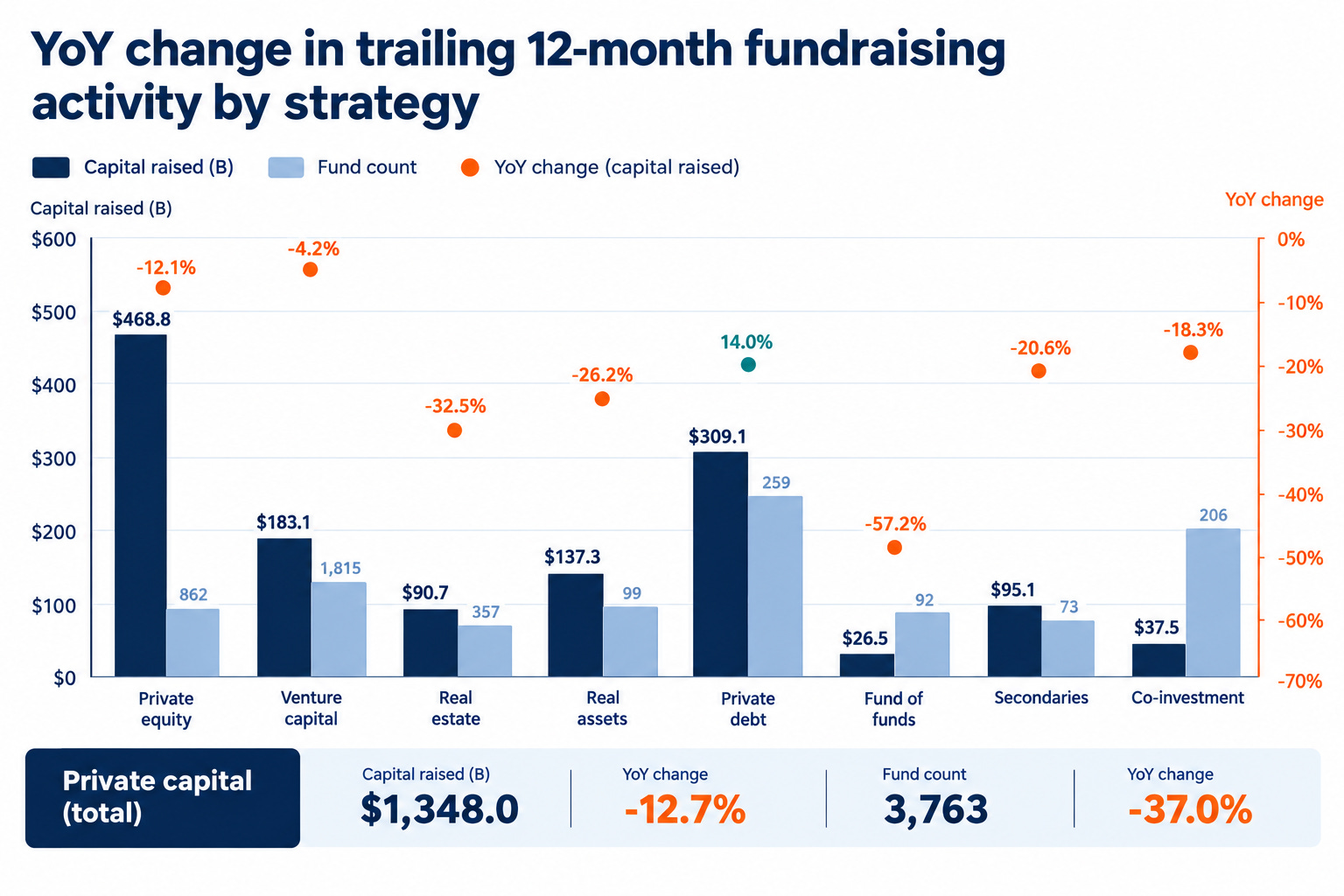
If one chart captures current sentiment, it is PitchBook’s year-on-year change in trailing 12-month fundraising by strategy. The top three strategies by capital raised will surprise no one: private equity, private debt and venture capital. The standout is private debt, the only strategy to raise more than a year ago, and by double digits (+14%). Venture capital and private equity raised less but held up reasonably well. Other strategies had a tougher year.
The more telling number is fund count. The number of funds closed fell by around a third, with declines across every strategy. Even private debt saw its fund count drop by nearly 40%. More capital is going to fewer managers.
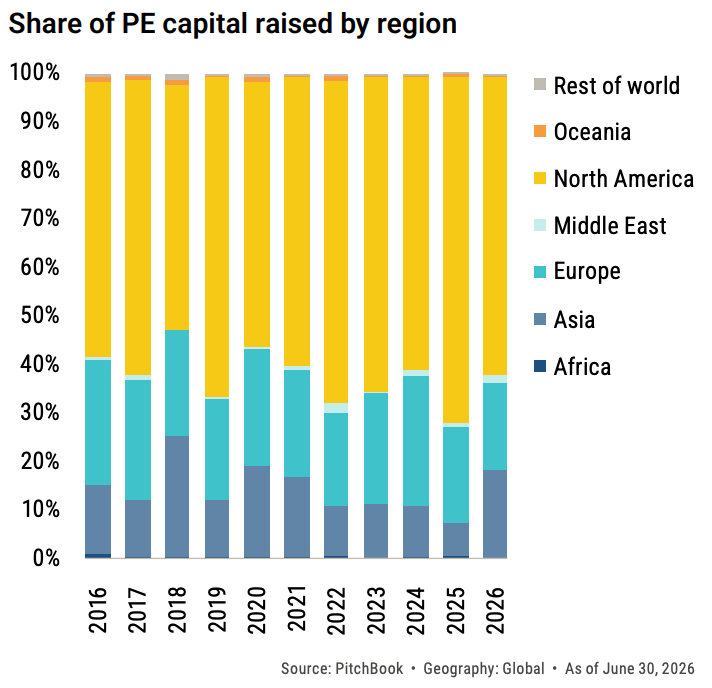
Fundraising by region
In private equity, Asia has seen a significant influx of capital. According to PitchBook, Asia-focused funds raised $48.3 billion in H1 2026, already more than the full-year 2025 total. Three closes drove most of it:
BPEA Private Equity Fund IX (Baring Asia, now part of EQT) at $15.6 billion
Blackstone Capital Partners Asia III at $13.1 billion
Bain Capital Asia Fund VI at $10.5 billion
Together they account for roughly 80% of the total. This rebound is as much a concentration story as an Asia story.
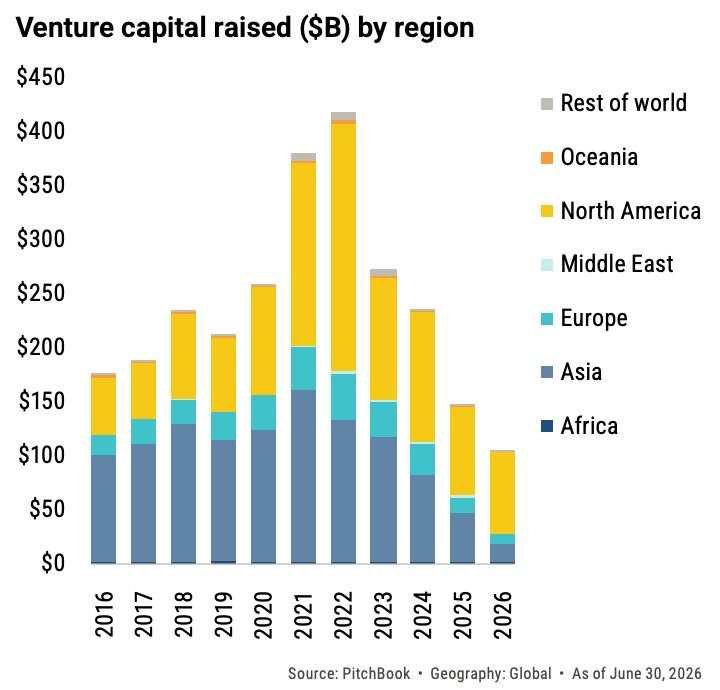
In venture capital, PitchBook’s analysis shows that US managers raised 20 of the 25 largest venture funds globally in H1 2026. A handful of firms accounted for roughly a third of all capital raised, including Andreessen Horowitz, Thrive Capital and Founders Fund, and their largest vehicles were all growth-stage funds. Asia continues to outpace Europe in venture fundraising. That gap looks set to widen as influential US firms build a local presence; Andreessen Horowitz, for example, announced a Tokyo office opening in summer 2026.
Capital in the ground: dry powder and NAV by age
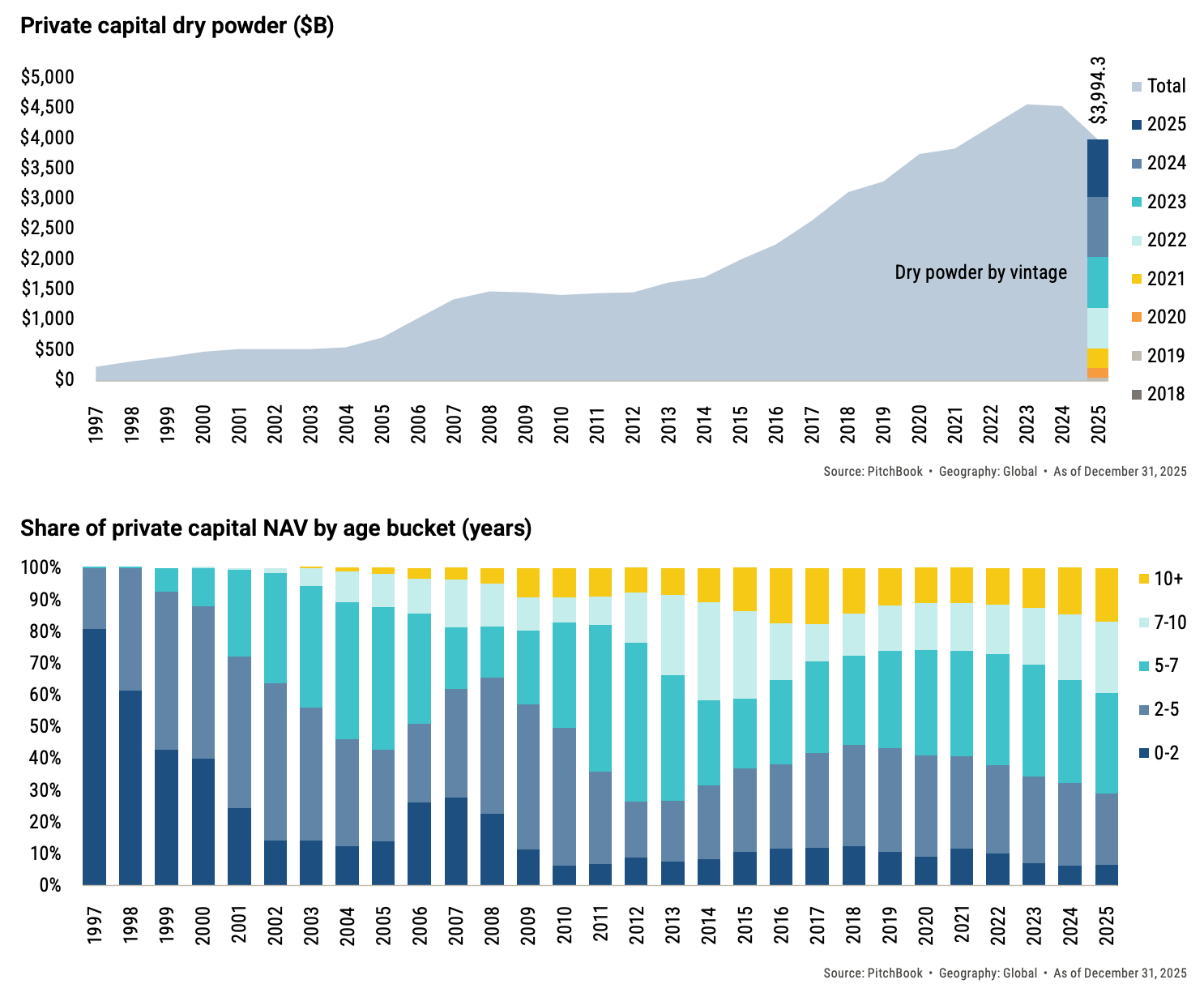
Dry powder has declined for a second consecutive year, reflecting slower fundraising, but still stands at around $4 trillion. The pressure to deploy is real, particularly for 2022 and older vintages approaching the end of their investment periods. Once that window closes, uncalled capital is, in theory, gone for good.
On top of that sits around $5 trillion of NAV. Of this, 39% is seven years old or more, a share that has risen steadily since 2021. Companies that should already have been sold still need GP time and resources. Exits are the obvious answer, but the market is not making them easy. As a result, the smartest GPs are focusing on efficiency, both in how they manage portfolio companies and in how they run their own firms.
Valuations
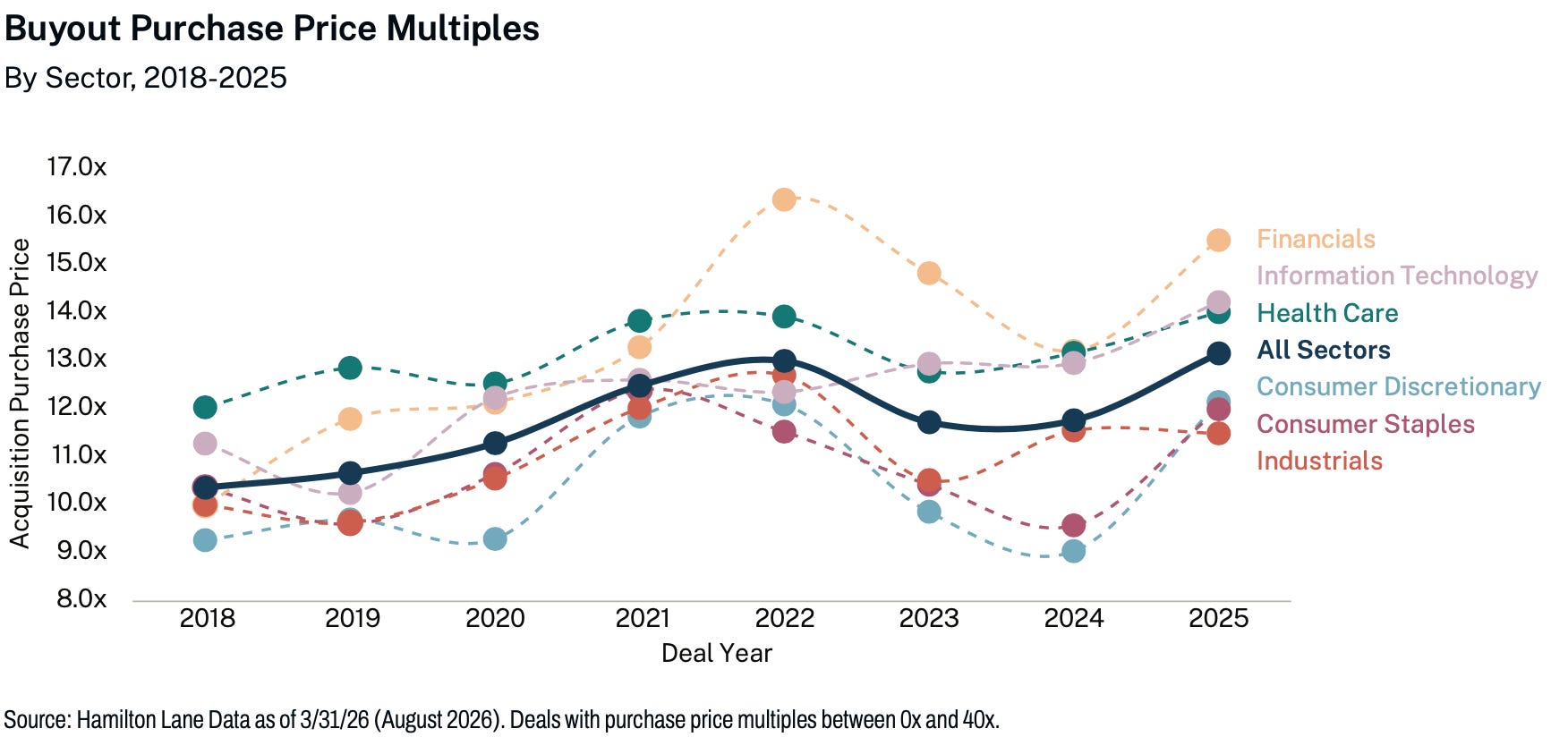
When it comes to purchase price multiples, 2021 and 2022 were the year “we shall not speak its name” or we shall not mention the prices we paid. However, everyone did and everyone is potentially in a similar situation. Or are they? Yes, 2021-2022 were peak pricing years, then went down in 2023 and especially in 2024, but now look at 2025 levels.
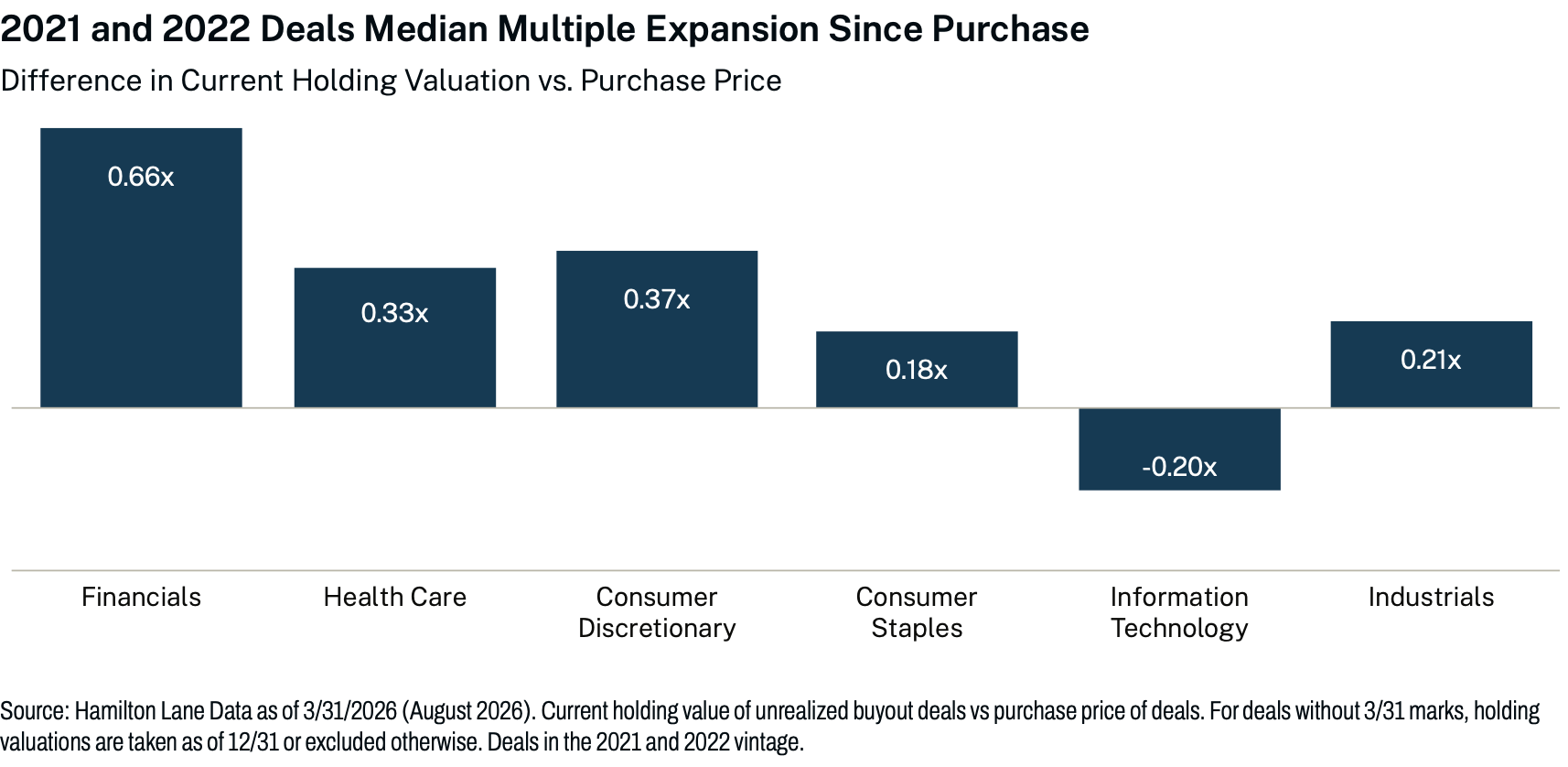
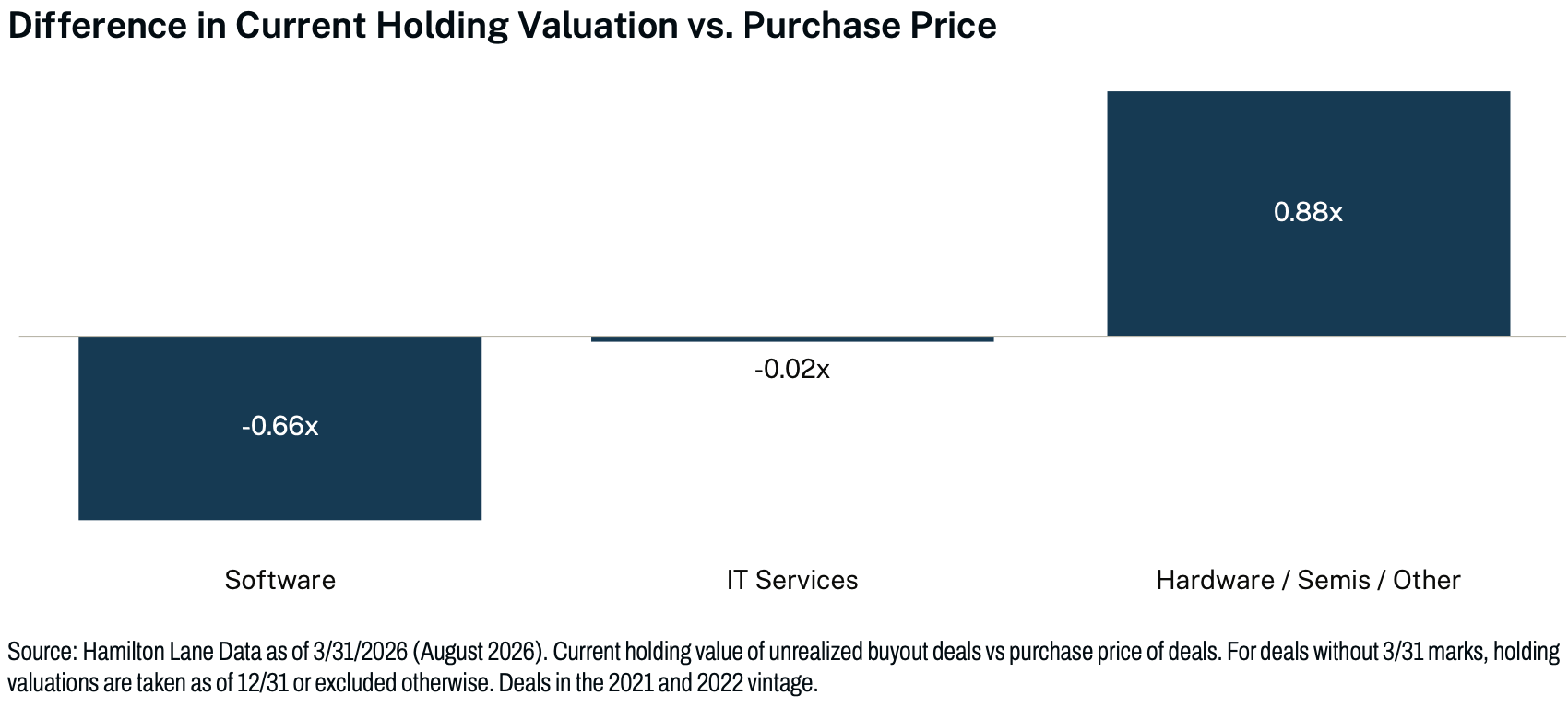
According to Hamilton Lane 2026 Mid-year report, 2025 multiples are back at or close to 2021-2022 levels, for sectors such as Information Technology, Health Care, Consumer Discretionally, with highest multiples still being paid in the Financials sector. In fact, Financials sector has shown the highest median multiple expansion since purchase in 2021 - 2022. When looked closer, Information Technology tells a more complex story. Whilst overall purchase price multiple continued to uptick, SaaSpocalypse left its mark on Software part, with multiple contraction of 0.66x, which was more than offset by multiple expansion of 0.88x on Hardware and Chips part.
The current multiple dynamics is indeed slightly surprising, given the broader industry narrative of slower exits and sluggish fundraising. However, let’s not forget that multiples don’t tell the full story. That is the quality of the investments that commanded such multiples in 2021-2022 might not be the same as they are now. Some might have paid 16x for sluggish growth, breakeven business in 2021 and are paying the same multiple for healthy revenue growth, EBITDA positive business. We don’t suggest that the dynamics is as described, this is merely to give an example of why purchase price multiples are better indicators of market sentiment rather than pure valuation lead.
Other themes to watch
Secondaries: still a small share of the market, but with an outsized influence on market structure and cash-flow dynamics.
Evergreen funds: not only attracting more capital, and more headlines, for better and for worse, but also changing industry dynamics in unexpected ways.
AI story: no investment theme can be discussed without taking AI into account. The headlines often suggest, technology and professional services story, what flies under the radar to some extent, how fast it is becoming a real assets story.
Return expectations
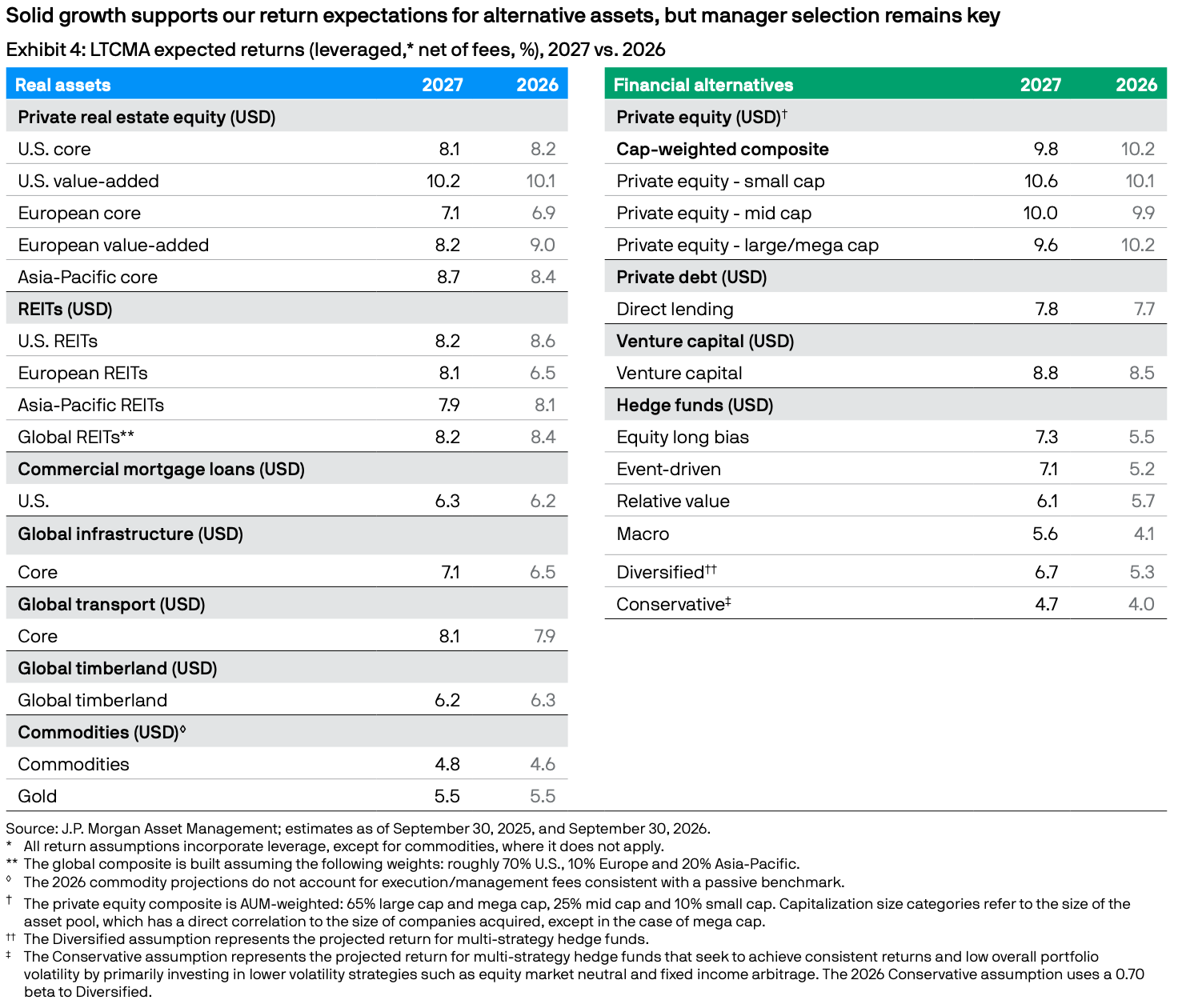
Just hot off the press, JP Morgan 2027 Long-Term Capital Market Assumptions report, continues to put the highest return expectation on private equity, with Private equity - small cap expected return of 10.6%. Real assets U.S. value-added follows the lead at 10.2% and private market - mid cap at 10.0%. Why? Let’s unpack that in the next article.